
Whether you’re tired of ducking under a shower head that’s too low, stretching to reach one that’s too high, or you’re planning a bathroom renovation and want to get the placement right the first time, you’re wondering about the standard shower head height.
You’ve come to the right place. The standard shower head height sits around 80 inches from the floor, but here’s the thing – that measurement doesn’t work for everyone.
Picture this: your 6-foot-4 teenager constantly hunching over to rinse shampoo while your 5-foot-2 spouse needs to jump just to adjust the spray settings. Sound familiar? The shower head height from floor varies quite a bit based on your household’s specific needs, the type of shower head you choose, and accessibility requirements.
ADA-compliant installations actually require heights between 38 and 48 inches for accessible showers. Meanwhile, those luxurious rainfall heads? They often sit higher at 85 to 90 inches to create that perfect cascade effect.
Getting the height right isn’t just about avoiding awkward shower gymnastics – it impacts your comfort, how well the shower functions, and honestly, whether you actually enjoy your daily shower routine. We’ll walk you through everything you need to know about choosing and adjusting the perfect shower head height for your specific space and family.
Trust us – taking the time to get this right will save you years of shower frustration.
Understanding the Standard Shower Head Height
Why 80 Inches Is Considered Standard
Most homes stick with the 80-inch benchmark for shower head height from floor because it accommodates the widest range of users. The measurement comes from average adult height statistics – around 5 feet 7 inches for women and 5 feet 9 inches for men. This placement lets water fall naturally over your body without forcing you into awkward postures or making you constantly adjust your stance.
Here’s what’s interesting, though: plumbers typically install showerheads at 80 inches above the floor, but the recommended height actually sits at 84 inches. Both measurements work within the acceptable range of 68 to 86 inches, which covers people from 5 feet to 6 feet 6 inches tall.
The standard exists not because building codes require it but rather as an industry convention. No regulations actually dictate shower head height. It’s simply what works for most people most of the time.
Professional plumbers often take a smarter approach, especially when working on custom homes. They ask about the tallest household member and place the rough-in accordingly so the finished shower head sits about 6 inches above that person’s head. This method accounts for the shower arm extension and downward angle while keeping everyone comfortable.
The Rough-In Height vs. Finished Height
The rough-in height measures differently than where your shower head actually ends up. Rough-in height refers to the center point of the water outlet pipe – also called the shower arm drop-ear elbow. This center point typically sits at 80 inches above the finished floor.
Shower valves need a separate measurement entirely. The rough-in height for shower valves usually ranges from 40 to 50 inches above the floor, though it can sit lower if your shower doubles as a bathtub.
These measurements matter more than you might think – corrections after the walls close become costly and disruptive. Get it wrong, and you’re looking at tearing into finished walls just to move a pipe a few inches.
When Standard Height Doesn’t Work for Your Home
Standard measurements fail when your household members fall outside typical height ranges. Someone taller than 6 feet 8 inches will find an 80-inch shower head downright uncomfortable. The good news? You can drop as low as 72 inches if needed, particularly for households with children or shorter adults.
Custom installations show just how flexible this can be. We’ve seen a plumber working with a 7-foot-1-inch client set the rough-in at 8 feet. On the flip side, a home designed for a 4-foot-5-inch occupant required a 6-foot shower placement.
The takeaway here? Standard shower head height serves as a starting point, not a fixed rule you’re stuck with.
Shower Head Height by Type and Style
Here’s where things get interesting – different shower head designs actually demand specific height requirements based on how they deliver water. Understanding these requirements helps you select and position fixtures that work with your bathroom layout and family’s needs.
Wall-Mounted Shower Heads
Wall-mounted fixtures are what you’ll find in most residential bathrooms, and they come in a variety of finishes, with stainless steel shower heads being a popular choice for their durability and clean look. These units attach directly to the shower wall and deliver a focused water spray. The 80-inch mounting height works for most users, though the comfortable range extends from 78 to 82 inches. This positioning provides effective water coverage for people of average stature without requiring adjustments.
Want a more customized approach? Calculate your household’s adult heights, determine the average, then add three to four inches to find the optimal placement. Simple math that makes a big difference in daily comfort.
Rain Shower Heads
Rain shower heads need additional clearance because water requires distance to spread into that luxurious rainfall pattern. Position these fixtures between 85 and 90 inches from the floor to allow water to disperse properly. Mount too low and you’ll get an aggressive spray that defeats the gentle cascade effect these units aim to deliver.
The design works particularly well with standard 8-foot ceilings, where the increased height still provides adequate coverage. Some installations benefit from positioning the fixture at least 3 to 6 inches above the tallest user’s head – especially if you want that true spa-like experience.
Handheld Shower Heads
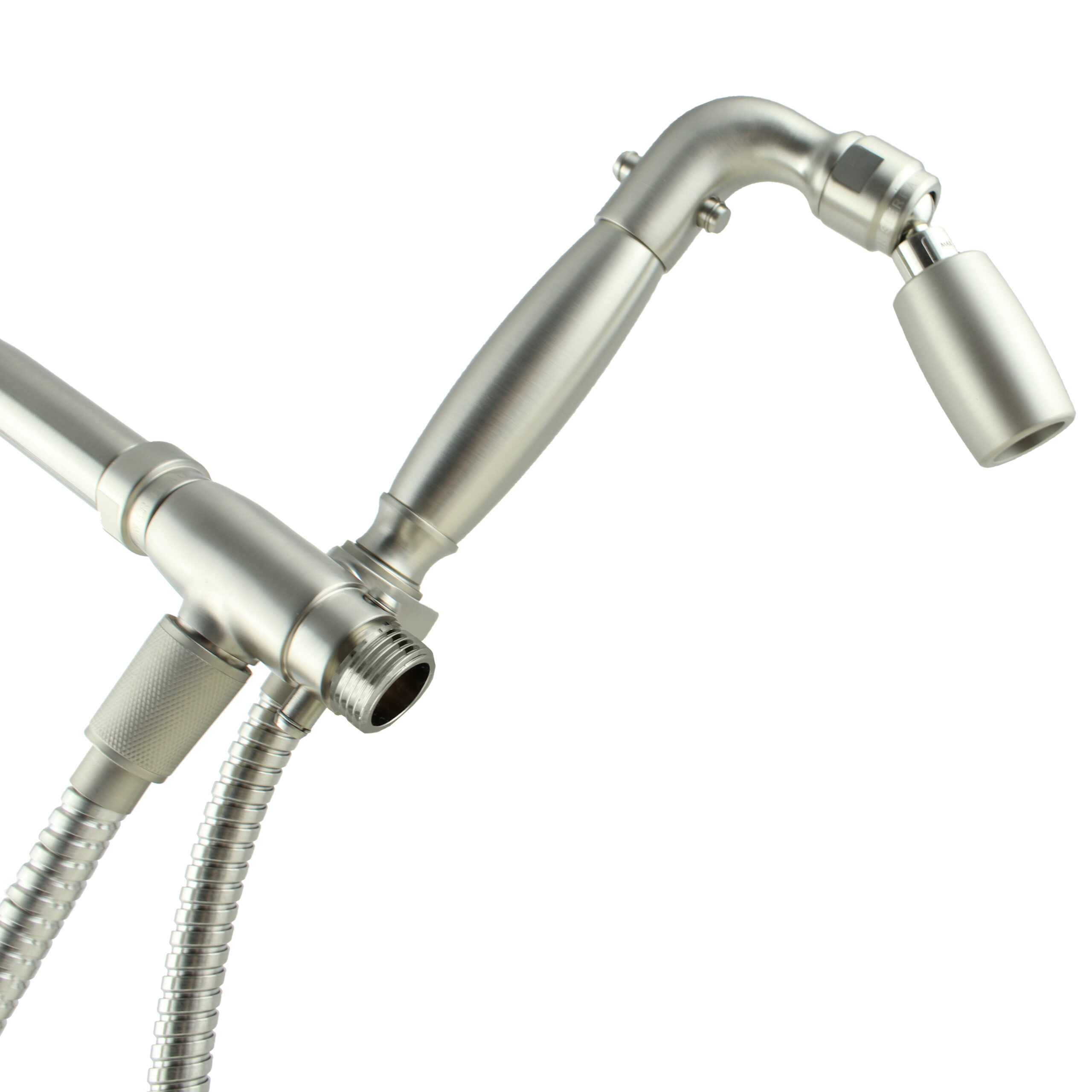
Handheld shower heads mounted on slide bars offer the most flexibility for households with varying user heights. The bracket typically installs at 72 to 78 inches, making it accessible for children and shorter adults. Slide bars extend the adjustment range from approximately 48 inches up to 78 inches, allowing each person to set their preferred height without tools.
This versatility makes them practical for cleaning tasks and pet bathing beyond standard showering needs. Perfect for those times when you need to rinse down the shower walls or give your furry friend a bath.
Dual Shower Head Systems
Combined systems pair a fixed overhead unit with a handheld component – the best of both worlds. The fixed head installs at the user’s optimal height while the handheld bracket mounts within easy reach. This configuration lets household members choose between the rainfall experience and targeted spray control. The handheld hose connects to a diverter that switches water flow between the two outlets.
Ceiling-Mounted and Overhead Showers
Ceiling-mounted installations position fixtures between 7 and 9 feet from the shower floor. This range provides enough distance for water to spread while maintaining warmth before reaching the user. Flush-mount models suit 8-foot ceilings, while taller spaces accommodate extension arms that bring water flow to the ideal dispersion level.
The key is ensuring adequate distance for water dispersion without losing heat – something that becomes more challenging with higher mounting positions.
Key Factors to Consider When Determining Height
You might think shower head height is just about measuring tape and math, but several other variables come into play that can make or break your shower experience. Recognizing these factors early helps you avoid the common mistake of just following standard measurements without considering what actually works for your specific situation.
Household Member Heights and Needs
Here’s where you need to get practical. Measuring the tallest household member gives you your starting point – then add 3 to 4 inches above that person’s height for adequate clearance. This isn’t just a suggestion – it’s the difference between a comfortable shower and daily frustration.
But what if you’ve got a household with serious height differences? Someone standing 6 feet 2 inches alongside a family member at 5 feet 4 inches creates real challenges that single-height fixtures just can’t solve. The short answer is this, though: adjustable systems typically outperform fixed installations when you’re dealing with these compromise heights.
Shower Arm Types and Their Impact
Don’t overlook the shower arm – it’s the piece that extends from the rough-in point and determines where water actually exits. Straight arms keep the shower head close to that 80-inch rough-in mark. But here’s where things get interesting: S-shaped or gooseneck arms can add 4 to 10 inches of height, potentially raising an 80-inch rough-in to 90 inches at the spray outlet.
That extra height affects both coverage patterns and user comfort without changing any of the underlying plumbing. Pretty convenient when you need to make adjustments without opening walls.
ADA Compliance and Accessibility Requirements
ADA standards get specific about accessibility – installations must sit between 38 and 48 inches above the finished floor for accessible showers. Handheld shower heads need hoses at least 59 inches long when mounted at or below 48 inches to accommodate seated users.
These requirements matter most for public facilities, hotels, hospitals, and senior-living environments, but they’re worth considering for any home where accessibility could become important. Adjustable height sliding bars and flexible hoses enable use from both seated and standing positions – something that’s becoming more popular in universal design.
Water Pressure Considerations
Something most people don’t think about until it’s too late: increased height above 80 inches can reduce perceived water pressure due to gravity and extended pipe length. Your shower system performs best between 40 to 60 PSI.
Rain shower heads are particularly picky – they need 45 to 60 PSI to recreate that gentle rainfall effect. If you’re dealing with lower water pressure, low flow shower heads and high-pressure models can counteract pressure loss at elevated mounting positions.
The takeaway? Test your water pressure before committing to that ceiling-mounted rainfall head you’ve been dreaming about.
Tools and Methods to Adjust Shower Head Height
Good news – you don’t need to tear into walls or call a plumber to fix a poorly positioned shower head. There are several smart solutions that work with your existing setup, and most take less than an hour to install.
If you’re comfortable with basic DIY tasks, you can handle these adjustments yourself. Really. We’re talking about simple connections that twist on and off.
Adjustable Shower Arms
Here’s where most people start, and for good reason. Adjustable shower arms connect your shower head to the water supply pipeline and give you the flexibility to position water exactly where you need it.
The hi-lo models are particularly clever – they feature multiple joints that provide a wide range of motion without sacrificing water pressure. You’d think all those joints would restrict flow, but they actually maintain water pressure rather than restricting it.
Look for stainless steel or solid brass construction if you want something that’ll last. These resist corrosion and withstand high pressure, heat, and minerals – all the stuff that typically destroys cheaper fixtures. The durable swivel joints support up to 3 pounds with safe, easy-to-tighten handle grips.
The best part? Universal 1/2-inch threads fit all standard shower plumbing, and installation takes minutes without tools. Just unscrew your old shower head, screw this on, then reattach your head. That’s it.
Shower Slide Bars
Slide bars solve the “one size fits nobody” problem better than anything else. These offer vertical adjustment typically spanning 24 inches, which means everyone in your household can find their sweet spot.
Here’s the setup that works best: install the bottom bracket at 52 inches above the tub floor and you’ll get adjustment from 52 to 76 inches high, accommodating most users. The handheld sprayer clips onto an adjustable slide-lock fitting that positions anywhere along the bar.
But slide bars aren’t just for height differences. This setup works brilliantly for bathing children, washing pets, and rinsing shower walls besides standard showering. Trust us – once you have a handheld option, you’ll wonder how you lived without it.
Installation requires mounting brackets into wall studs or using toggle bolts for hollow walls. It’s straightforward work, but you’ll want to locate those studs first.
Swivel Ball Adapters
Sometimes the simplest solutions work best. Swivel ball adapters install between the shower arm and shower head, adding 30 degrees of adjustment. Not dramatic, but often enough to eliminate that annoying spray-in-the-face problem.
The standard 1/2-inch connection fits most shower heads and arms. Installation involves removing the existing shower head, applying thread seal tape, and hand-tightening the adapter. These adapters maintain existing water pressure through high-flow internal pathways – so you’re not trading performance for adjustability.
Perfect for renters or anyone wanting a quick fix without permanent modifications.
Final Thoughts on Shower Head Height
There you have it – getting your shower head height right doesn’t require tearing apart your bathroom or calling in expensive contractors. The 80-inch standard works for most homes, but the real difference comes from thinking about your specific household needs.
Whether you’re dealing with a family where dad towers over everyone at 6’3″ while mom barely reaches 5’2″, or you’re planning an accessible shower for an aging parent, the solutions are simpler than you might think. Adjustable systems, slide bars, and flexible arms solve most height challenges without breaking the bank.
The key takeaway? Measure your tallest household member, add three to four inches, and you’ve got your target height. Whether you’re installing a rainfall head that needs that extra clearance or a handheld system for maximum flexibility, this simple rule creates the foundation for years of comfortable showering.
Simple adjustments really do deliver lasting improvements. Your future self will thank you every morning when you’re not hunching over or stretching to rinse your hair properly.